
PROJECT BRIEF
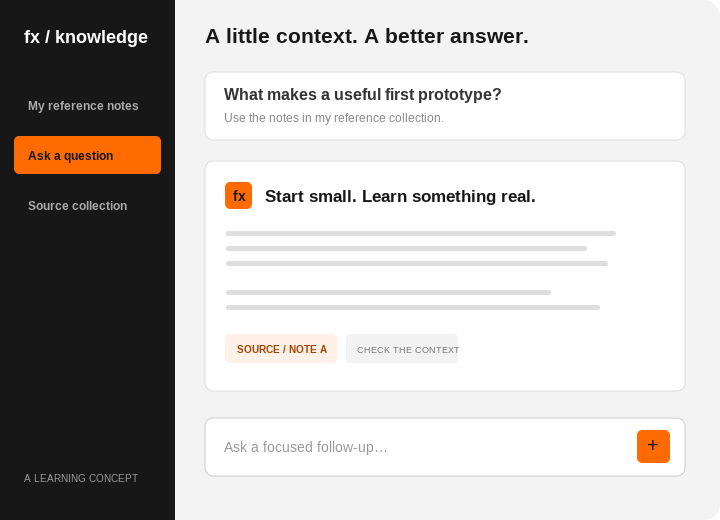
A knowledge assistant
Turn a small set of notes into answers you can trace back to their source.
Explore the project briefUnderstand the fundamentals, frame a useful problem, and learn how to judge whether an AI idea works.
Start with the relationship between a task, the data available, and the output you need. Compare a fixed rule with an approach that learns patterns from examples. Describe what the system can observe and what it cannot know from those inputs alone.
What you’ll leave with: A task description and a simple baseline.
Make the goal small enough to investigate. Identify who would use the result, how they would judge it, and which mistakes matter. Decide where a person should stay in control before you consider automating anything.
What you’ll leave with: A focused problem brief with clear boundaries.
An experiment is only as informative as the examples you use to test it. Start with material you have permission to use. Describe what the examples represent, what they omit, and how you would handle private or sensitive information.
What you’ll leave with: A small, documented evaluation set.
Compare a first version against your baseline using the same examples. Look at individual failures rather than only the average result. Write down what you would change and how you would tell whether the next version improved.
What you’ll leave with: An experiment summary and one next step.
You’ve marked every module complete. Download your plan, revisit an experiment, or use what you learned to explore a project brief.
Turn a small set of notes into answers you can trace back to their source.
Explore the project brief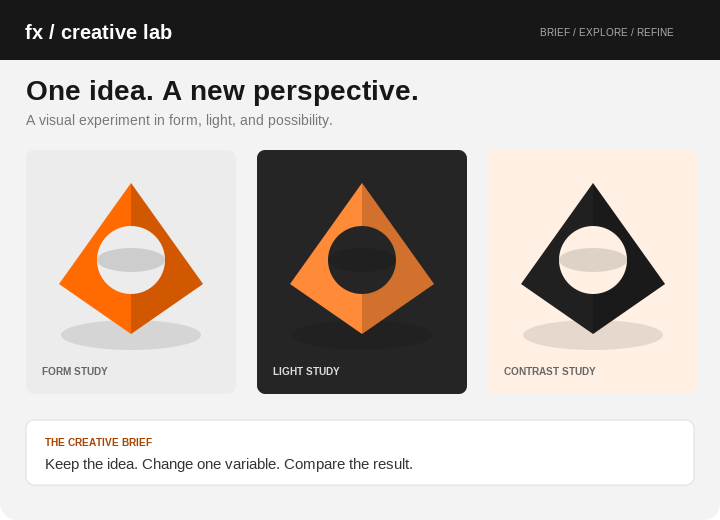
Take one visual idea from a clear brief to a considered, documented result.
Explore the project brief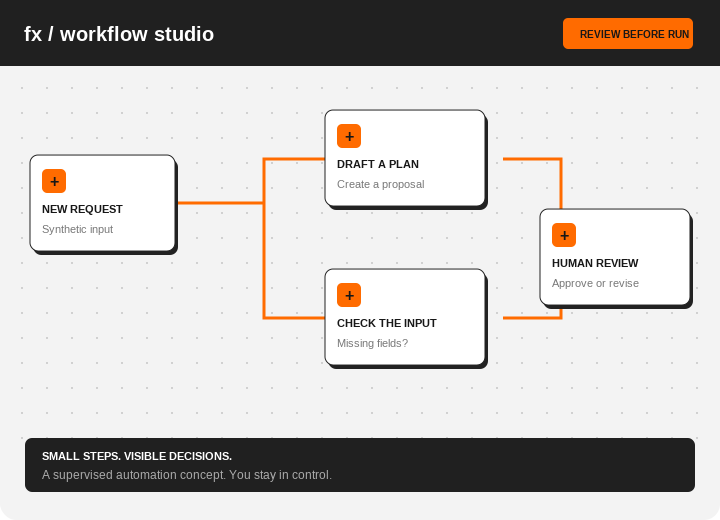
Prototype a useful workflow with clear boundaries and a person in control.
Explore the project briefIllustrative project briefs for your own experiments. These are starting points, not examples of completed member work.